
Thursday, February 14, 2019

Wednesday, February 13, 2019
A Crucible of Torment
Throughout this portion
of “The Knight of the Cart” the heroes are repeatedly mocked and tormented for
various reasons. Some are blunt with their demeaning language towards them,
while others more subtly hint that they are not strong, smart or worthy enough
to continue along their quest.
This first appears when
the knight mocks the king and his knights that they are powerless to retrieve
the mass of prisoners he is holding, “I tell you the news not because I intend
to return them to you. On the contrary, I simply wish to inform you and serve
notice that you don’t have the force or wealth to free them” (The Knight of the
Cart, 171), to which the king seems to agree. This then persists as the knight
is shamed for riding in a cart through the city, with all manor of jeers
shouted towards him (The Knight of the Cart, 175). The knight then meets a woman
who forces him to be with her despite any objections he made, followed by her
using her own knights to stage an assault on herself (?) in order to test him
(The Knight of the Cart, 184). He is then further attacked by knights claiming
that he is not worthy to ride alongside the woman, “An escort so wretched
indeed that I shall take you away now” (The Knight of the Cart, 189).
Through all of this they
persist, continuing along their quest despite the various demoralizing words
and actions of those who opposed them, staying true to their morals and honor.

Anonymous
Why does Chretien de Troyes refer to Lancelot as only "the knight in the cart," oppose to Lancelot? Why are there so many characters that don't receive names? Does it make other characters who have names more meaningful, or is there no reason behind it?


Monday, February 11, 2019
Testy, testy
 This second half of Erec
and Enide seemed like it dealt with themes of testing the quality of character for many of the acting parties in the text. These tests
were not limited to the two primary protagonists for whom the text is named,
but also extended to tests of faith, chivalry and honor, as well as tests of
love and perseverance. Erec is shown to be headstrong and cocky but he is also capable
of great acts of kindness and mercy. I found the polar behaviors of the knights
in the story to be odd, specifically, the rapidity at which a chance meeting of
a fellow knight was escalated to violence, and the equal speed at which the
situation resolved itself amicably. I believe these merciful culminations acted
as a test of the victor’s capacity for mercy and compassion – perhaps strange
qualities to value in trained warriors, but values which are frequently
questioned and tested nonetheless.
This second half of Erec
and Enide seemed like it dealt with themes of testing the quality of character for many of the acting parties in the text. These tests
were not limited to the two primary protagonists for whom the text is named,
but also extended to tests of faith, chivalry and honor, as well as tests of
love and perseverance. Erec is shown to be headstrong and cocky but he is also capable
of great acts of kindness and mercy. I found the polar behaviors of the knights
in the story to be odd, specifically, the rapidity at which a chance meeting of
a fellow knight was escalated to violence, and the equal speed at which the
situation resolved itself amicably. I believe these merciful culminations acted
as a test of the victor’s capacity for mercy and compassion – perhaps strange
qualities to value in trained warriors, but values which are frequently
questioned and tested nonetheless.
Enide
was effectively tormented through the entirety of the second half of the tale,
dealing with a moody Erec, a dead Erec, a not-dead Erec, and a not-dead-not-Erec-husband,
all while being attacked at regular intervals. Ultimately, I think Enide had a
happy ending, but only through her unwavering commitment and survival of Erec’s
trials. Enide’s ability to remain faithful and selfless eventually payed off,
though I still can’t help but feel that Enide was always on the receiving end
of emotional trauma. In many ways, Enide’s ability to survive any trauma of the
mind mirrored Erec’s capacity to survive any damage to his body, and while that’s
great for a wandering couple of lovers, I’m not sure it lends itself to a happy
marriage down the road.
[commentary refers to Chretien de Troyes' "Erec and Enide" as translated by David Staines, Indiana Uni. Press, 2010]
ALL YOU NEED IS FAITH

This reminded me of how Enide kept faith in Eric even when he gave her multiple reasons not to . Also how she kept faith in him when she was abducted and forced to married the count. This is shown on pages 59- 60.
The Bigger Picture
Discussion Question:
What does the story of Erec and Enide say about the role women play in this time period? Does Enide make Erec a better Knight?
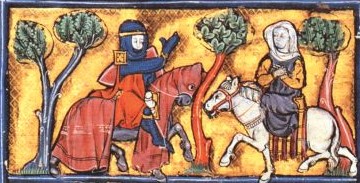
What does the story of Erec and Enide say about the role women play in this time period? Does Enide make Erec a better Knight?
Eric's Beloved

“With the war raging within, she spoke to
herself. ‘My loss would be too terrible, I know that for certain, were I to
lose my lord here. Then shall I tell him everything openly? Absolutely not.
Why? I would not dare, for my lord would be furious. And if my lord is angered,
he will abandon me in this thicket and leave me alone and wretched. Then I
shall be even worse off. Worse off?” (page 47)
Enide’s monologue to herself continues, “If I
alert him of the coming knight, I will end up alone without my love, but if I
do not alert him, my love will be killed, and I will still end up without my
love.”
While Enide’s internal war with her thoughts
evolves, the knight gains speed on his horse with determination. He is
approaching Erec without his knowledge. Erec is in a different world; he is
looking at the morning sky oblivious to the knight racing to cause his
impending death. The cloud he was looking at was majestic; its beauty made him
think of the love he has for Enide; his heart throbbed for her, but he had to
finish this excursion to prove his knighthood is still apart of him.
The knight aims his lance at Erec’s chest. Erec finally hears the sound of the approaching knight on his horse. He is in such a
daze from looking at the sky, so it is hard for him to react to what is a shock
to his eyes. He is able to quickly put his shield up, but he is not fast
enough. His shield makes a loud clang as the knight’s lance hits the shield,
and the shield is knocked out of Erec’s hand. He was not able to have a hard
grasp on it since he was just coming out of a day dream looking at the sky. The
knight’s lance pierces Erec’s skin and impales his chest. The force he received
from the hit knocks him off his horse.
Enide shouts for her love, “Oh Erec! I should
have warned you of the knight. I took too long to make my decision. Your death
is my fault; the weight of this moment resides on my shoulders.”
Subscribe to:
Posts (Atom)